Make promises
that outlive
your company.

Eon Reserve makes long-term obligations independently funded and transferable — so your customers can trust a 30-year promise without betting on your company lasting 30 years.

A place to begin

Define the promise.

Create a brief to guide the conversation about your obligation. Your draft downloads to your device; nothing is submitted.

A starting point for planning your reserve and continuity.

See how Eon works
A series of enduring stone arches extending toward an open horizon
Built for what comes next.

For promises measured in decades.

A 30-year promise assumes a 30-year company.

Companies get acquired. Founders leave.
Operators fail. Records disappear.

The obligation remains.

Illustrative durations. The promise sets the horizon.

The principle

Infrastructure for promises
measured in decades.

Fund the obligation today. Protect the reserve. Ensure someone can fulfill it tomorrow — even if your company can’t.

Follow one promise through time.Illustrative 30-year obligation

Year 0of 30

A promise made.A future accounted for.

Your company issues a 30-year obligation. Its reserve and records are established from the beginning, alongside a plan for who could take over.

Original provider

Performing

Reserve & records

Established
Remain with the obligation

Successor provider

On standby

The original provider does the work. Continuity is already part of the plan.

01 / 04Scroll to follow the promise ↓

An illustrative solar warranty

See one promise through.

A $28,000 solar installation.
A 25-year workmanship warranty.
One plan for what happens next.

Year 0

At installation.

  1. Customer pays $28,000

    For the installation and its 25-year workmanship warranty.

  2. $420 continuity reserve established

    A portion is set aside for the defined obligation.

  3. Warranty state registered

    The terms, customer record, and service history travel with the promise.

  4. Acme Solar remains primary servicer

    The original provider continues to perform the covered work.

Year 14

Acme Solar closes.

  1. Trigger detected

    The shutdown is verified against the agreed transition conditions.

  2. Customer record preserved

    The warranty terms and service history remain available.

  3. Qualified successor assigned

    A replacement servicer takes over under the continuity arrangement.

  4. Protected reserve funds covered work

    The successor uses the reserve according to the warranty’s scope and funding terms.

Through year 25

The company ended.
The warranty didn’t.

Illustrative scenario, not an active Eon obligation. Acme Solar is fictional. The $420 reserve is not a quote or an underwriting result; actual funding, coverage, limits, and successor availability require obligation-specific assessment and agreements.

The Eon framework

Everything a promise needs to outlive its maker.

Capital alone isn’t continuity.
The funding, the people, and the knowledge
need to last together.

Capital

Reserve engine

Fund the promise

Calculate how much must be funded today to support an obligation over its full lifetime.

Protected reserve structure

Protect what’s set aside

Structure reserves so they remain separate from ordinary operating capital.

Continuity

Successor network

Plan for who comes next

Identify another provider with the capability to take over and fulfill the obligation.

Trigger system

Know when to act

Define the events that activate a transition: insolvency, shutdown, license loss, SLA breach, or abandonment.

State

Portable records & state

Carry the knowledge forward

Preserve the structured records, instructions, and operating context a successor needs to continue performance.

Governance & audit

Make continuity verifiable

Establish oversight and evidence that the reserve and continuity mechanism actually exist.

For the company making the promise

Make the promise
more valuable.

A long history tells customers where you’ve been. A continuity plan shows them what happens next.

The promise to work toward
“Your obligation is independently continuity protected.”

A statement to earn through funded, documented arrangements.

Strengthen long-duration guarantees

Make the financing behind tomorrow’s service explicit.

Address a buyer objection

Give customers a way to evaluate the promise beyond your company’s expected lifespan.

Differentiate the product

Two companies can both offer 25 years. Explain what happens in year 18 if yours disappears.

Make longer promises responsibly

Plan the funding, records, and successor arrangements for the full term of the commitment.

Including us

Eon shouldn’t have
to survive either.

A continuity system that depends on Eon existing forever would reproduce the problem it was built to solve.

No single company should be indispensable to a decades-long obligation. Including us.

  1. Eon operating companyReplaceable
  2. Protected reserves + obligation recordsPersist
  3. Independent custodian / successor administratorContinues performance

The design objective. Independence must be established through the final custody, legal, record-access, and administration arrangements.

What your customer could receive

A promise with
a record behind it.

A clear account of what is owed, who made the promise, and how its continuity is arranged.

Continuity you can verify.

Reserve status, custodial state, and continuity readiness should be inspectable—not matters of faith.

An illustrative record design. The statuses shown are examples, not verified reserves or active protection.

EonIllustrative record

Continuity Record

Solar workmanship warranty · 25 years

Originating provider
Acme Solar
Issued
September 29, 2026
Protection through
September 29, 2051
Illustrative reserve
$420
Reserve status
Fully funded
Records
Current
Successor servicing
Enabled

Example only. No active protection.
Subject to the terms of an executed arrangement.

The practical questions

The details
are the point.

Eon’s proposed model, and what each arrangement needs to establish.

Is Eon insurance?

Eon is being designed as continuity infrastructure: a way to coordinate funding, records, and successor performance around a defined obligation. That is not, by itself, an insurance policy. If a particular arrangement needs insurance, the coverage, insurer, limits, and exclusions would be specified separately.

Where is the reserve held?

The intended model is a reserve held separately from ordinary operating capital, under an obligation-specific custodial, trust, or other legal arrangement. The holder, account structure, and oversight must be identified in the final documents; no universal custodian or structure is being represented here.

Can the originating company access it?

Access and release rights must be set out in the governing agreement. The design objective is to restrict use to the defined obligation and permitted costs, rather than allow the reserve to function as the company’s general cash balance. The final legal structure determines those rights.

How is the required reserve calculated?

Reserve sizing would account for duration, expected service costs, timing, inflation, uncertainty, administration, and transition costs. It must be evaluated for the specific obligation and reviewed over time. The $420 solar reserve shown on this page is an illustration, not an underwriting result, price, or assurance of sufficient funding.

What triggers a successor?

The agreement would define qualifying events, the evidence required, who determines that a trigger has occurred, and how a transition is authorized. Events could include insolvency, shutdown, license loss, a defined SLA breach, or abandonment. A trigger does not automatically mean a claim is covered.

Who performs the obligation if the original provider disappears?

The intended model is a qualified successor with the relevant capabilities, permissions, and access to the obligation’s records. Availability and transition terms must be established for each arrangement. This site does not represent an already-contracted successor network.

What happens to unused reserves?

The governing documents must specify when an obligation is complete, any remaining claims period, permitted fees, and who receives residual funds. There is no blanket promise that unused reserves return to the originating company or to the customer.

Can an existing obligation be protected?

An existing obligation could be assessed, subject to its terms, available records, funding needs, required consents, and successor feasibility. It would need its own review and executed arrangement; creating a brief does not establish protection.

What happens if Eon itself fails?

The design objective is that reserves and portable records remain accessible under arrangements that allow an independent administrator to take over. That independence has to be established through actual legal agreements, custody, record access, and transition procedures. It is an architectural goal, not a claim that those arrangements are already in place.

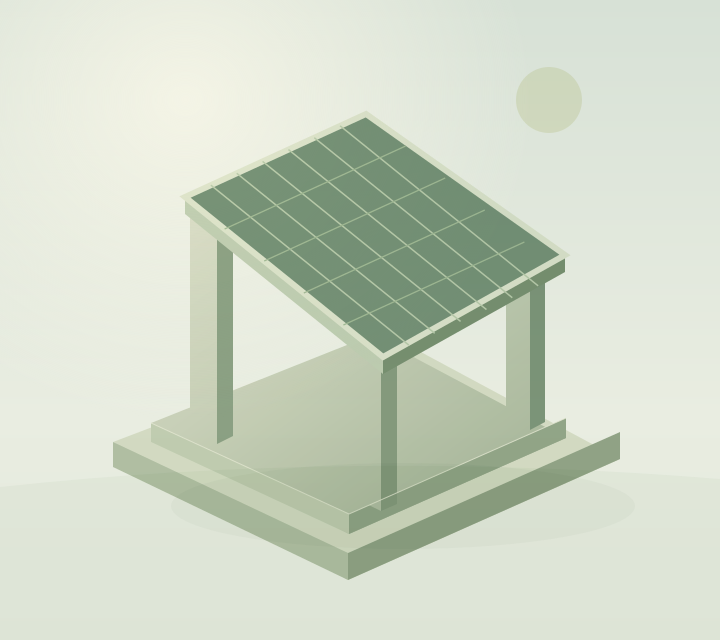
A promise is only as strong as what stands behind it.

Build for a future
beyond your own.

Start with the obligation. Design for its whole life.

A place to begin

Define the promise.

Create a brief to guide the conversation about your obligation. Your draft downloads to your device; nothing is submitted.

A starting point for planning your reserve and continuity.